
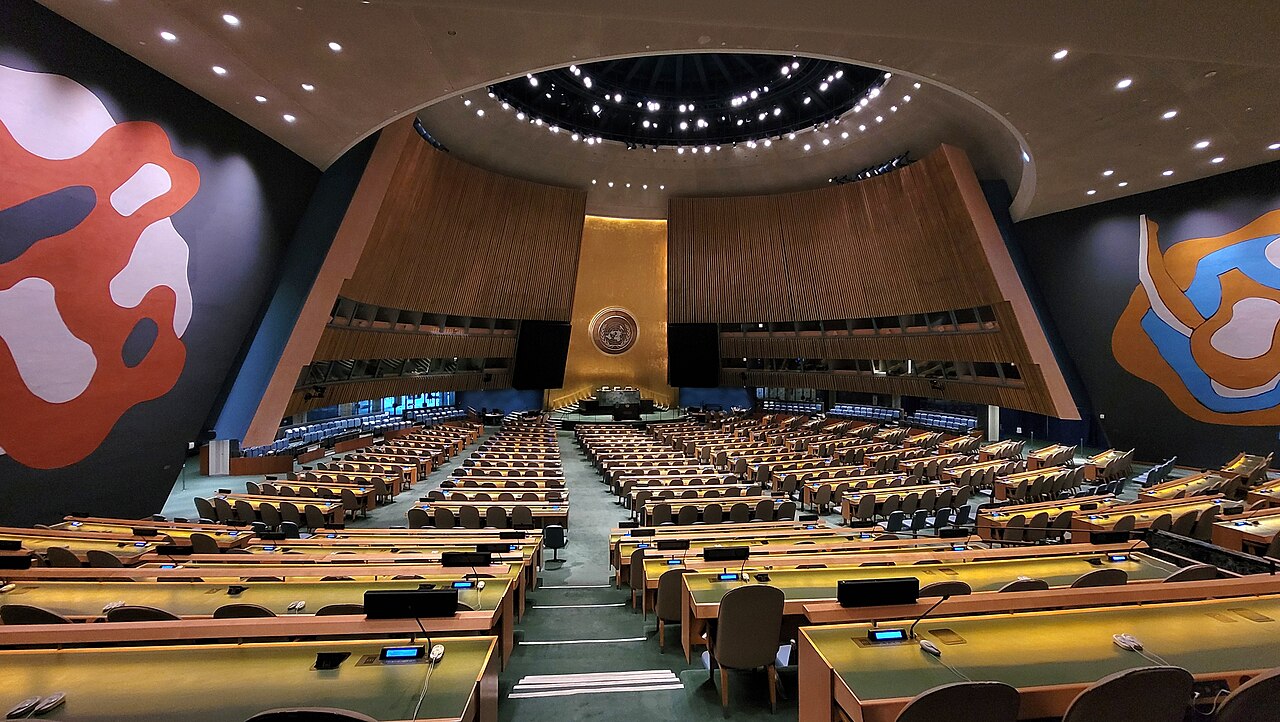
At this year's U.N. General Assembly, African leaders renewed their demand for permanent seats on the Security Council, arguing that a continent of 54 member states and roughly 1.6 billion people should not be shut out of the body that makes some of the world's most consequential security decisions. The call is not new, and it would be easy to file the speeches under routine diplomatic rhetoric. That reading, however, misses what has changed. The African Union submitted a detailed reform model to the U.N. earlier this year, calling for at least two permanent seats with veto power, for as long as the veto exists, plus five additional nonpermanent seats. The longstanding grievance has now become a concrete institutional proposal.
The Security Council’s five permanent members, the United States, Russia, China, France and Britain, have held their seats since the U.N. was founded in 1945, while African countries have only held rotating seats, underscoring calls for the continent to have permanent representation on the Council. Yet African leaders are pressing their case well beyond the Council. Botswana's president, Duma Boko, argued that developing countries should help set standards for emerging technologies and govern the resources that underpin them, while other leaders raised development financing, critical minerals and energy. Taken together, the speeches challenge a system in which decisions on security, finance and technology are routinely made without comparable African influence.
There is some evidence the argument is landing. Secretary-General António Guterres has repeatedly backed greater African representation, and the current Council reform process explicitly acknowledges Africa's underrepresentation. But recognition is not power. Amending the U.N. Charter requires approval by two-thirds of the General Assembly and ratification by two-thirds of member states, including all five permanent members on the Security Council. As a result, the countries that benefit most from the current structure hold a formal veto over changing it. Washington, Moscow, Beijing, Paris and London can endorse African representation in principle while doing nothing to bring it about, and the process gives them every opening to do so.
Africa also faces an obstacle of its own making. The African Union has kept a common continental position rather than naming which states would fill the permanent seats. Nigeria, Egypt and South Africa, among others, have expressed interest. Unity on principle could fracture once the question shifts from whether Africa should be represented to who gets to represent it, and the existing powers have every incentive to exploit that divide. A bloc that cannot agree on its own delegates hands its opponents an easy reason to delay.
Still, the campaign's value does not depend on a Charter amendment passing. Institutional power rarely moves in a single vote. It moves when states accumulate enough economic and diplomatic leverage that existing institutions have to respond—and Africa has more of that leverage than it did a generation ago. The Democratic Republic of Congo produces most of the world's cobalt, a key input for electric vehicle batteries, and the continent holds large reserves of copper, lithium and other minerals that major powers are competing to secure. African governments have increasingly pushed to process more of those materials at home rather than export them raw, treating access as a bargaining chip. The African Union's admission as a permanent member of the G20 in 2023 showed that this economic weight can open doors that U.N. diplomacy alone has not.
For international relations, this contest matters for three reasons. First, it shows that emerging regions now measure influence by control over resources and technology, not only by formal seats. Second, it exposes how little the postwar institutional order has adapted to the world's demographic and economic shifts. Third, it tests whether the permanent five will treat reform as a threat to their position or as a way to preserve the legitimacy of the institution they lead.
The speeches, then, are neither empty symbolism nor proof that the global balance of power has shifted. They are the opening of a longer contest over who writes the rules of the international order. Whether this campaign becomes a real redistribution of power will depend on whether African governments can agree among themselves, and on whether the countries that benefit from the current system are willing to give up some of their own.
Aiyana Kaul is a staff writer for On The Record from London, UK and a sophomore in the SFS studying IPOL.